
Modality Disentangled Learning for Incomplete Multimodal Emotion Recognition: A Primitive Memory Distillation Perspective
EMNLP 2026 Findings!
1Jiangsu University · 2Griffith University · 3National University of Singapore · 4University of New South Wales
5Fujian University of Technology · 6Xi'an Jiaotong-Liverpool University · 7German Research Center for Artificial Intelligence
8Tsinghua University · 9Technical University of Munich · 10Imperial College London · 11Queen Mary University of London



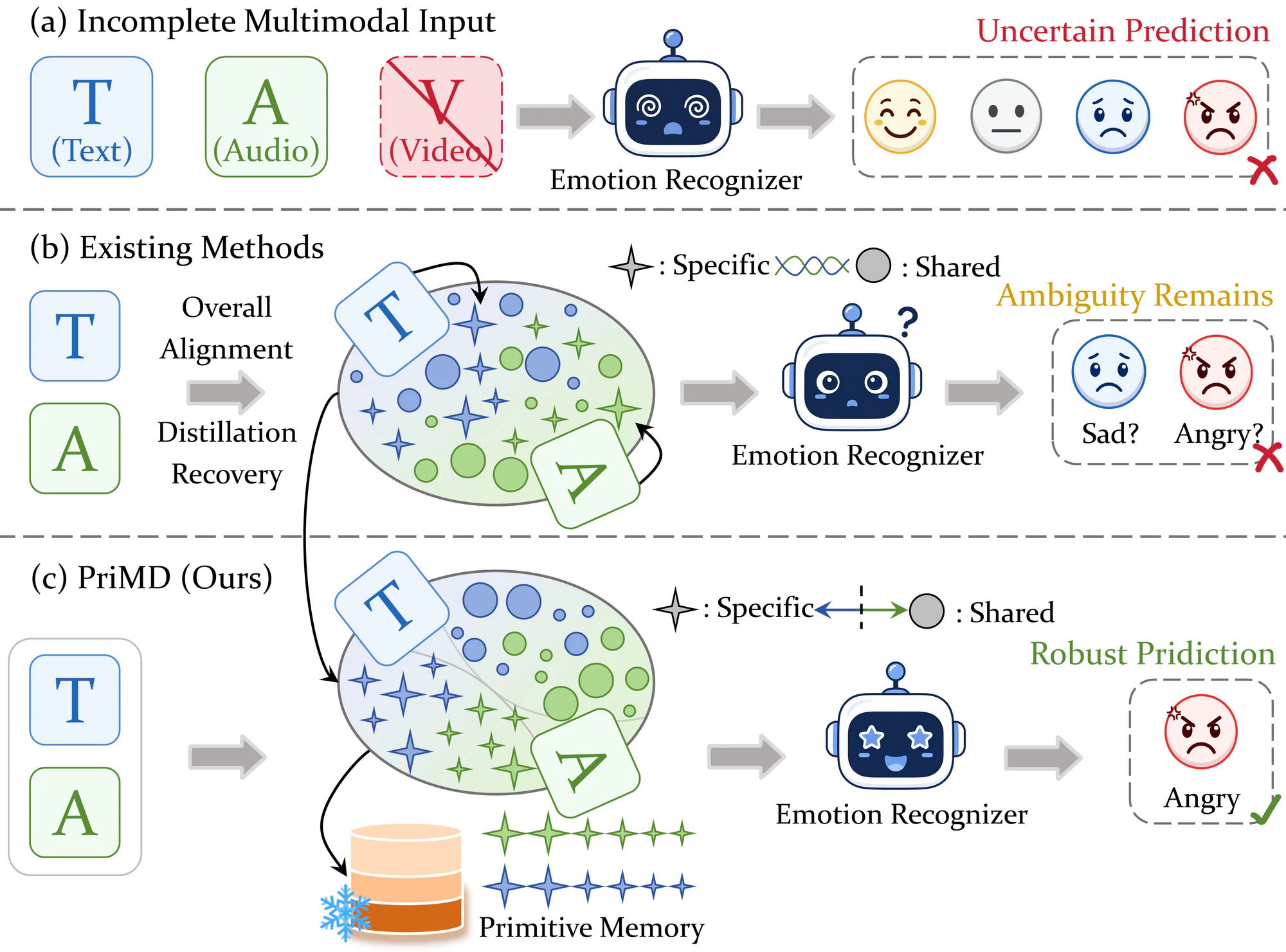
Our research focuses on the problem of missing modalities in multimodal emotion recognition. By examining existing approaches, we found that many methods generate, align, or distill a missing modality as a whole, overlooking the fact that different information components within a modality are not equally recoverable. Cross-modal shared emotional semantics can usually be reliably estimated from the available modalities, whereas modality-specific details are inherently more uncertain. Processing these two types of information together can produce ambiguous or even conflicting representations, leading to unstable predictions under different missing-modality conditions. Based on this insight, we propose PriMD, which reformulates the missing-modality problem as shared semantic estimation and constrained compensation of modality-specific information. PriMD first disentangles these two types of information, then organizes modality-specific information into discrete primitive memories and uses the shared semantics of the available modalities to dynamically retrieve relevant primitives. By avoiding unconstrained inference of the entire missing modality, PriMD enables more stable and robust emotion recognition.
Abstract
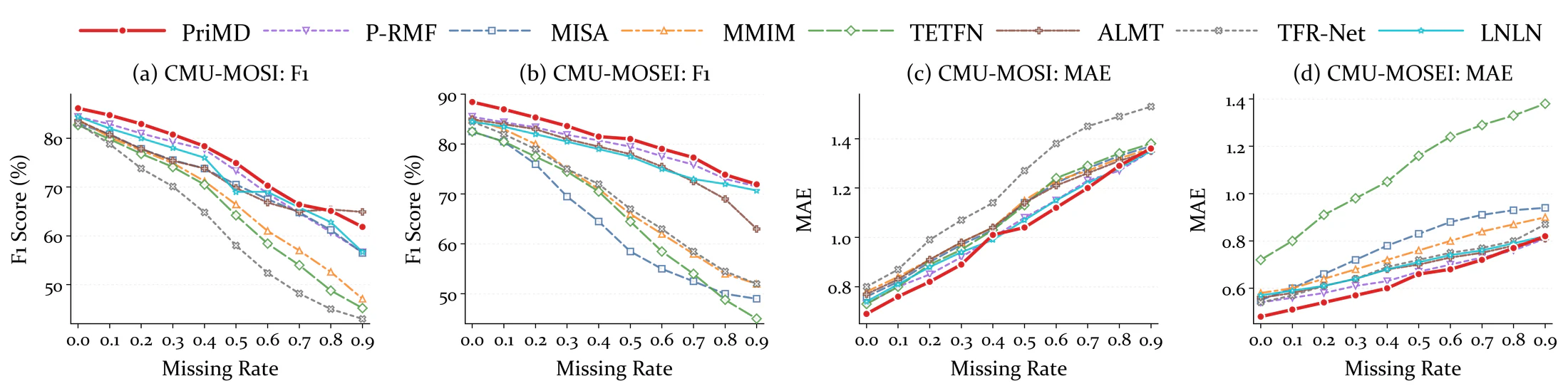
Multimodal Emotion Recognition (MER) systems often suffer from missing modalities in real-world scenarios. Existing methods usually generate, align, or distill missing modalities as a whole, overlooking the heterogeneous nature of the information carried by each modality. Such holistic treatment mixes inferable shared semantics with uncertain modality-specific details, yielding unstable representations and degrading robustness. To address this issue, we propose the Primitive Memory Distillation (PriMD) framework. Unlike existing methods, PriMD takes an intra-modal perspective and focuses on how different types of information within a modality differ in recoverability within each modality. PriMD first disentangles cross-modal shared semantics from modality-specific representations, and then discretizes the latter into learnable semantic primitives to construct modality-specific memory banks. When modalities are missing, PriMD is a teacher-student framework that the student model uses the shared semantics of available modalities as queries to dynamically retrieve primitives. It compensates for missing modality-specific information within a constrained memory space and aligns with the teacher model. Extensive experiments on IEMOCAP, CMU-MOSI, and CMU-MOSEI demonstrate that PriMD achieves state-of-the-art performance and consistently stronger robustness across a wide range of missing-modality settings, while mitigating the instability caused by holistic feature inference.
Method Overview
PriMD consists of a full-modality teacher model and an incomplete-modality student model. The teacher model first disentangles complete multimodal representations into cross-modal shared semantics and modality-specific information, and then constructs a discrete primitive memory based on the modality-specific information. In the student model, when some modalities are missing, the model dynamically retrieves relevant primitives according to the shared semantics of the available modalities to compensate for the missing modality-specific information. Finally, PriMD aligns the student model with the full-modality teacher model via retrieval-augmented distillation.
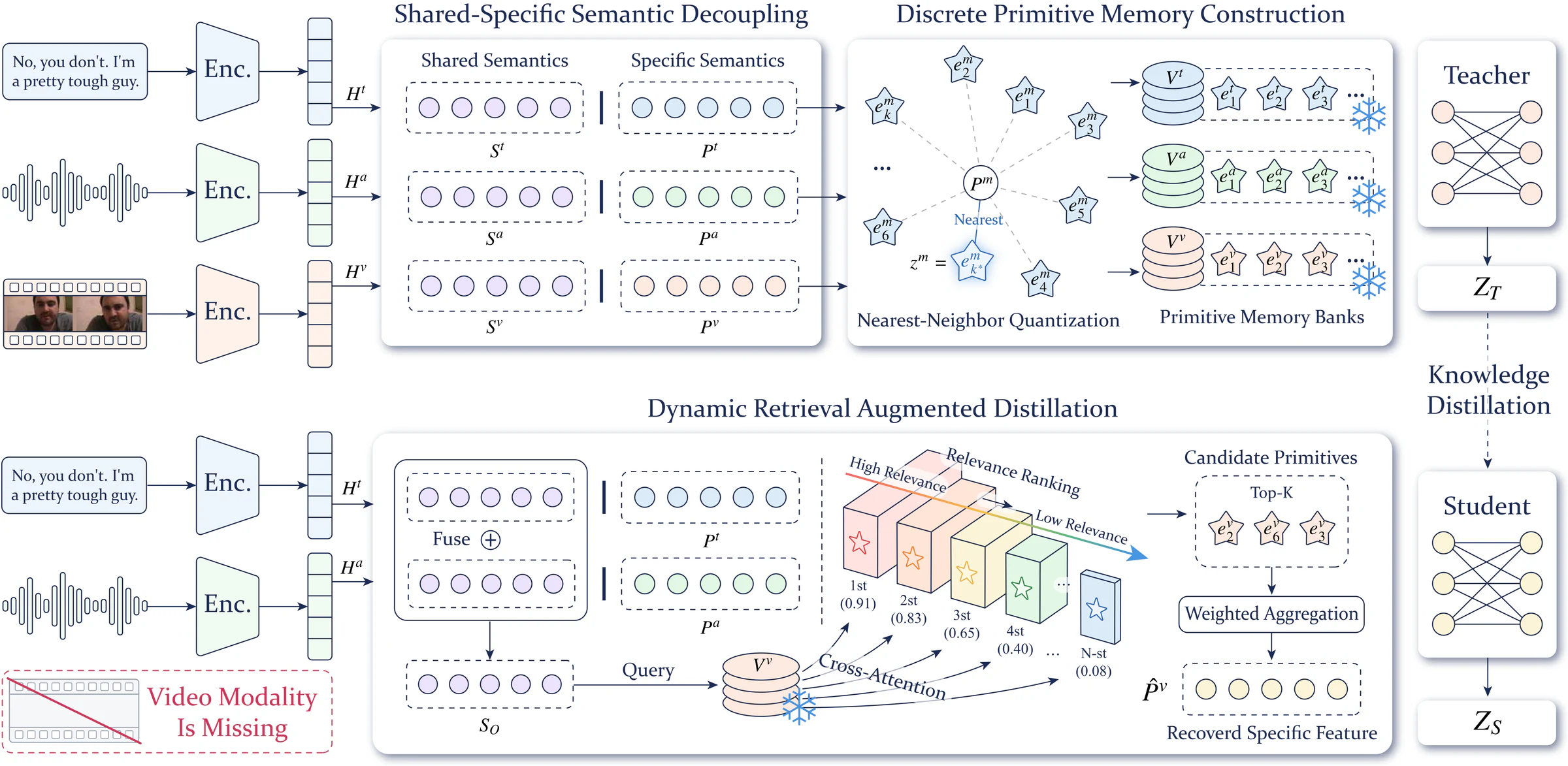
- We revisit incomplete MER from an intra-modal perspective and formulate it as a unified process of shared-semantic estimation and constrained compensation of modality-specific information.
- We design SSSD to disentangle shared and modality-specific features, and DPMC/DRAD to discretize the modality-specific space into semantic primitives and retrieve them for compensation under missing modalities.
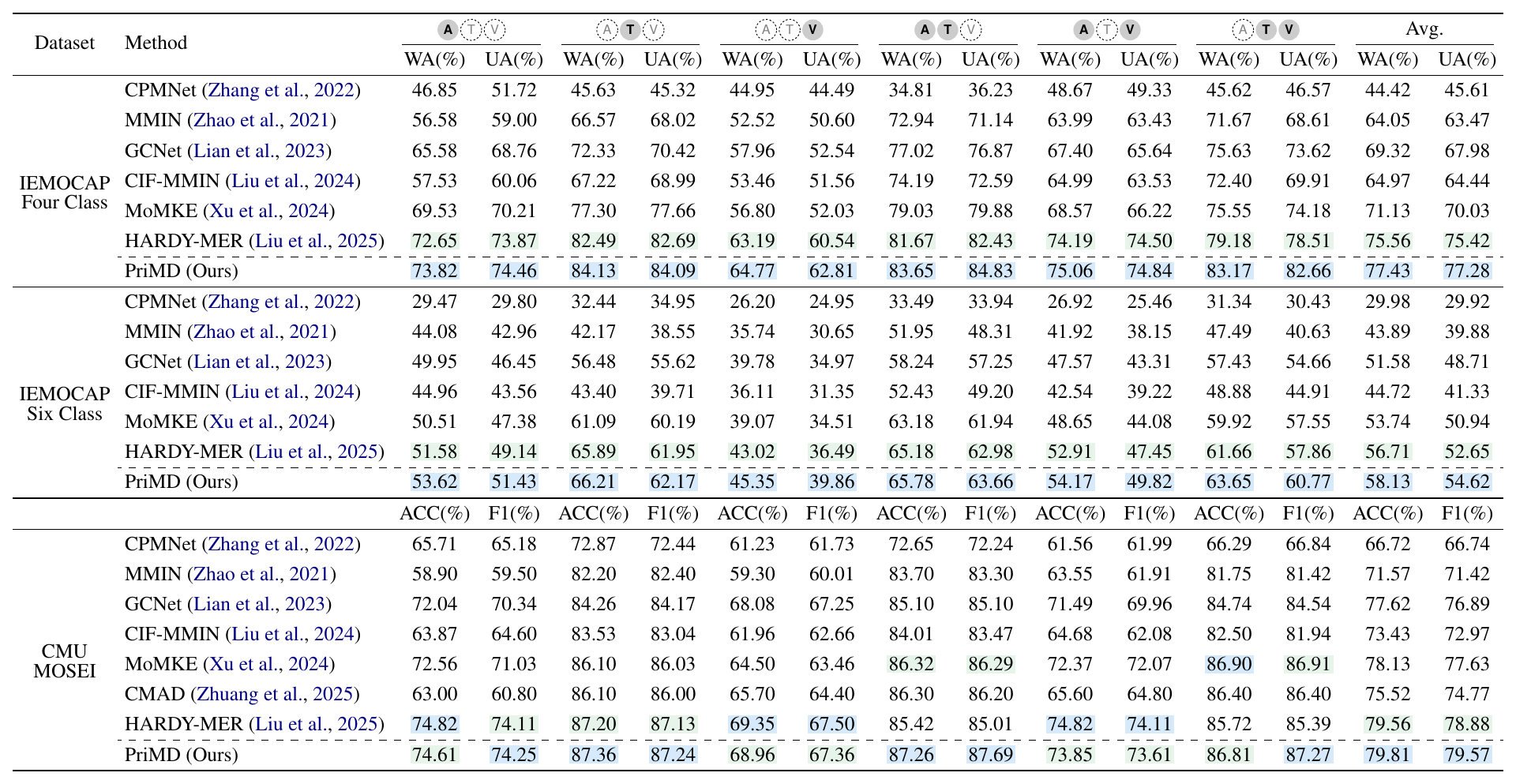
- Extensive experiments on three benchmarks show that PriMD outperforms prior methods under diverse missing-modality settings, with especially large gains when two modalities are absent.
Comparison with SOTA Methods
Inter-modal Missingness
Intra-modal Missingness
Ablation Study
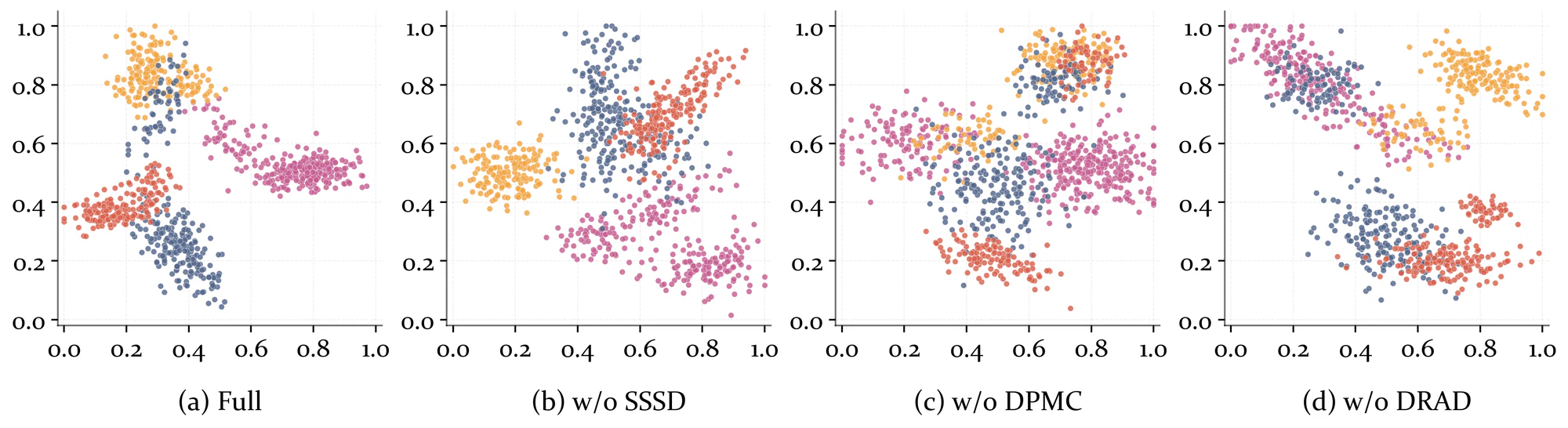
w/o SSSD. Replacing the two projection branches with a single projection yields one entangled representation per modality and reduces average performance to 74.36% WA and 74.05% UA. Mixing shared and modality-specific information makes subsequent memory construction and distillation vulnerable to redundant or unstable modality-specific information.
w/o DPMC. Removing DPMC reduces average WA/UA to 75.95%/75.76%. This confirms that discrete primitive memory provides a constrained compensation space for uncertain missing modality-specific information.
w/o DRAD. Removing DRAD causes the largest degradation, to 72.31% WA and 72.10% UA. Representations from the available modalities alone cannot adapt to different missing-modality combinations.

Computational Efficiency
PriMD reduces the parameter count, training time, and peak CUDA memory by 79.7%, 51.4%, and 82.2%, respectively, compared with HARDY-MER, while increasing inference latency by 8.1%.

Visualization Analysis
Fused Representations
Using only the text modality, the complete PriMD model produces a clearer class structure than its ablated variants: samples from the same class are more compact, while overlap between different classes is reduced.
Primitive Retrieval Patterns
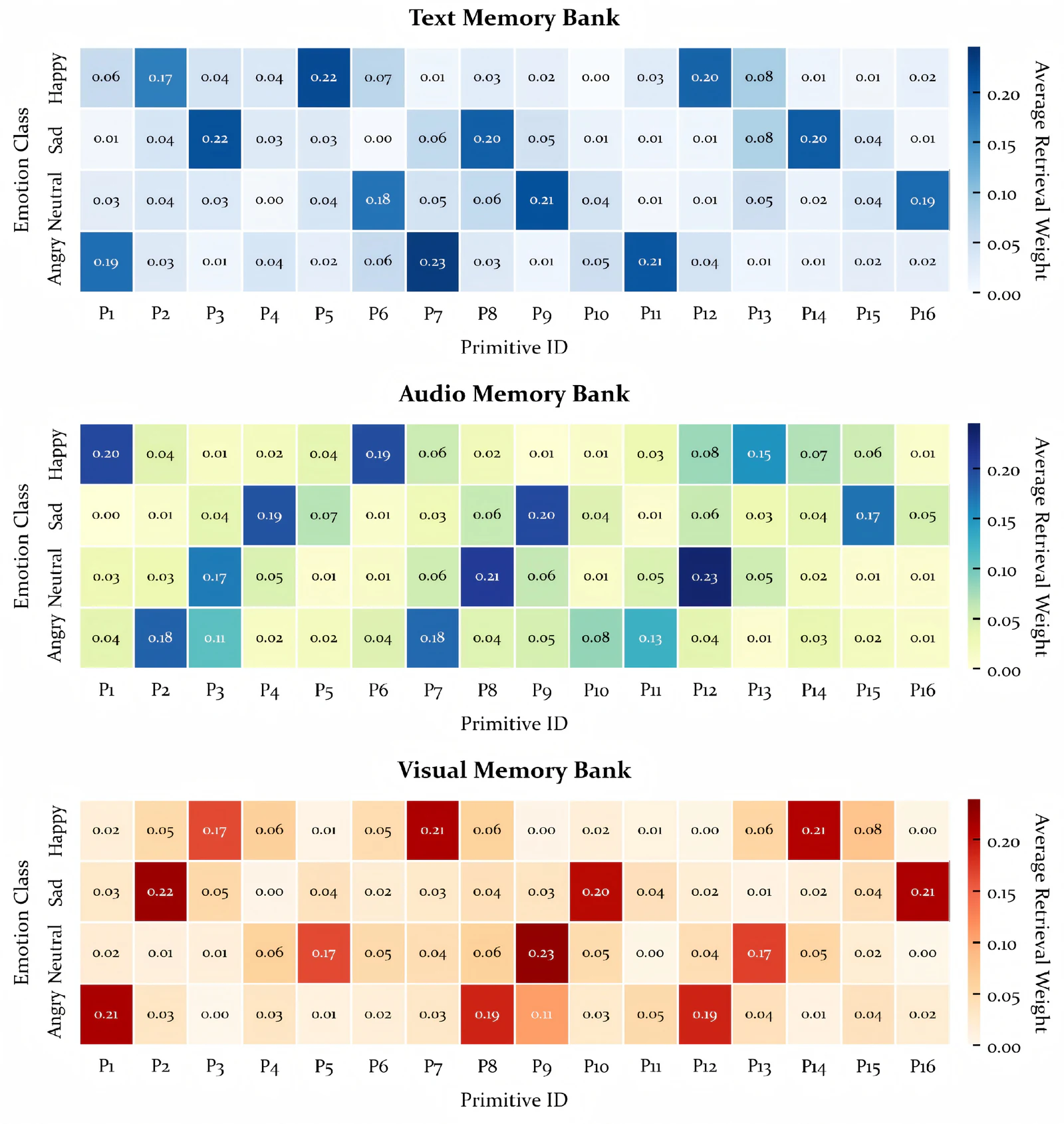
Different emotion categories activate different subsets of primitives within each memory bank, while the audio, text, and visual banks learn distinct modality-specific primitive distributions.
BibTeX
@inproceedings{zhang2026primd,
  title     = {Modality Disentangled Learning for Incomplete Multimodal Emotion Recognition: A Primitive Memory Distillation Perspective},
  author    = {Jiaqi Zhang and
               Zheng Pang and
               Mengting Li and
               Yiqi Wang and
               Guangyuan Dong and
               Chao Xue and
               Yusen Wu and
               Zihao Li and
               Huy Phan and
               Sicheng Zhao and
               Bj{\"o}rn W. Schuller and
               Jiachen Luo},
  booktitle = {Findings of the Association for Computational Linguistics: EMNLP 2026},
  year      = {2026}
}