ReBridge-Flow: Re-Coupling Posterior Bridges in Flow Matching for Image Restoration
1Jiangsu University · 2Griffith University · 3Sichuan University · 4University of Malaya
5University of Science and Technology of China · 6Tianjin University
7University of Southern Queensland · 8Southern University of Science and Technology
Abstract
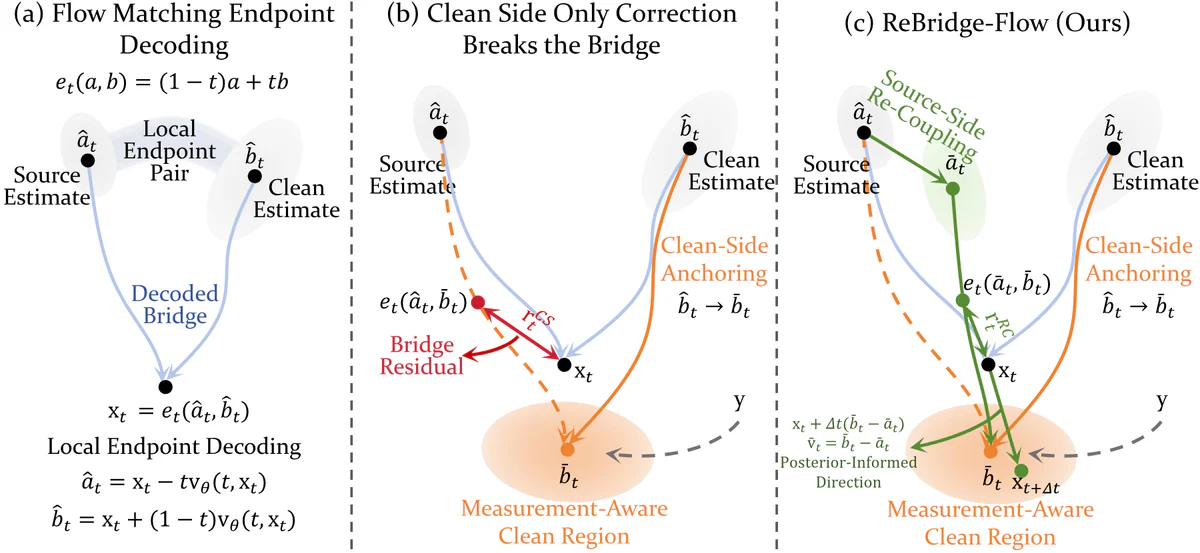
Flow Matching provides an efficient generative prior for image restoration by learning continuous transport between source and data distributions. However, existing methods typically incorporate measurement constraints through local corrections. Such corrections may disrupt the source-clean endpoint coupling implicitly encoded by the pretrained flow, making the corrected endpoint pair incompatible with the current state. To address this issue, we propose ReBridge-Flow, a posterior bridge re-coupling method. Given the current state, ReBridge-Flow decodes the corresponding local source and clean endpoints, incorporates measurement information through clean-side anchoring, and synchronously re-couples the source endpoint. The re-coupled pair defines a posterior-informed transport direction that improves local bridge compatibility and structural consistency across natural and medical image restoration tasks.
Posterior Bridge Re-Coupling
ReBridge-Flow treats image restoration as measurement-conditioned endpoint re-coupling instead of an isolated correction to a state, velocity, or clean endpoint. This keeps the local bridge and its transport direction compatible with the current Flow Matching state.
-
01
Local Endpoint Decoding
Decode source and clean pseudo-endpoints from the current state and pretrained velocity field.
-
02
Clean-Side Anchoring
Inject the observation through a noise-aware correction that preserves the local flow prior.
-
03
Source-Side Re-Coupling
Synchronously update the source endpoint and form a posterior-informed direction for the next state.
- We identify bridge mismatch as a source of trajectory error in Flow Matching-based image restoration.
- We introduce the Posterior Bridge Defect to jointly characterize measurement error, flow-prior deviation, and bridge residual.
- We derive clean-side anchoring and source-side re-coupling as a unified closed-form posterior bridge update.
BibTeX
@article{zhang2026rebridgeflow,
  title   = {ReBridge-Flow: Re-Coupling Posterior Bridges in Flow Matching for Image Restoration},
  author  = {Jiaqi Zhang and Yiqi Wang and Hongjie Wu and Bohan Guo and Xinan Wang and Zichen Luo and Taotao Cai and Zhi Chen and Mingkai Zheng},
  journal = {arXiv preprint},
  year    = {2026}
}